Loading…
Network
Publish and resolve large verified UHRP content with CHIRP, or connect to Teranode's P2P network and subscribe to real-time blockchain events.
Packages in this Domain
| Package | Purpose |
|---|---|
| @bsv/chirp | Progressively publish and resiliently resolve BRC-167 chunked Merkle content over UHRP |
| @bsv/teranode-listener | Subscribe to Teranode P2P topics via libp2p DHT with gossipsub pub/sub messaging |
What You Can Do
- Listen for new blocks — Real-time block solution events from Teranode
- Monitor subtree updates — Track subtree creation and validation
- Track mining status — Subscribe to mining enabled/disabled events
- Monitor peer connections — Handshake messages from connecting peers
- Detect rejected transactions — Receive txid of transactions rejected by network
- Custom topic subscription — Dynamic add/remove of topic callbacks at runtime
- PNET-compatible DHT participation — Join mainnet with its public compatibility value or configure a private network PSK
Key Concepts
- PNET DHT — Uses a 32-byte PNET value for network compatibility; the published mainnet value is not authentication
- Gossipsub — Efficient pub/sub messaging layer for blockchain event distribution
- Topic-based subscriptions — Subscribe to specific events (bitcoin/mainnet-block, bitcoin/mainnet-subtree, etc.)
- Bootstrap peers — Known entry points for discovering other peers in the network
- Static peers — Explicitly configured peers maintained for reliable connectivity
- Peer discovery — libp2p Kademlia DHT discovers peers dynamically
- Callbacks — Each topic has own async message handler for processing events
- Message format — Events arrive as raw Uint8Array; caller deserializes (typically BSV transactions/blocks)
- Trust boundary — Topic messages, sender names, and propagation peers are untrusted until application claims are independently verified
When to Use
Use network packages when you need to:
- Monitor real-time blockchain events
- React to new blocks as they arrive
- Track peer connectivity and network health
- Run an overlay service that listens for transactions
- Build applications that need live blockchain state updates
When NOT to Use
- For transaction broadcasting — use transaction submission endpoints
- For historical queries — use indexers or explorer APIs
- For UTXO lookups — use full-node RPC or @bsv/overlay lookup services
- Without requirement for real-time updates — use batch query APIs
Architecture Overview
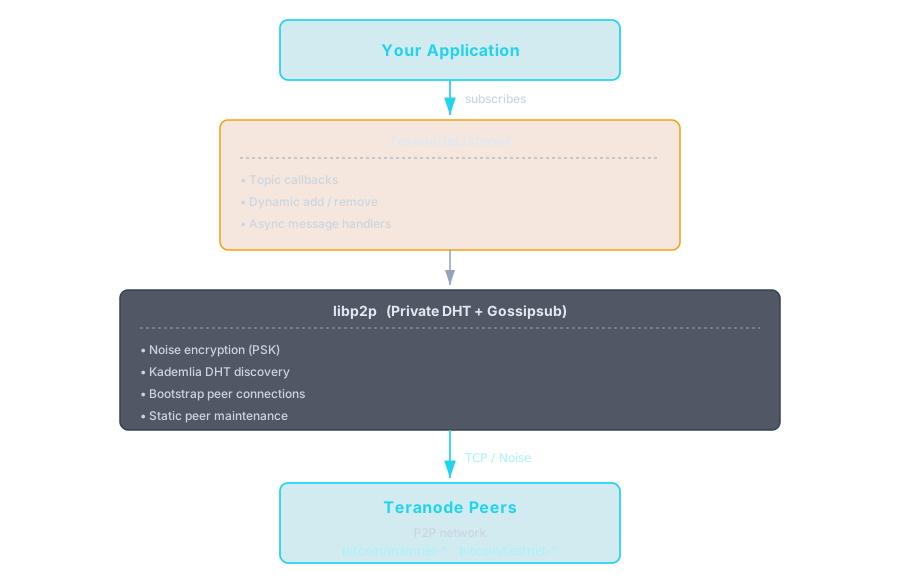
Topics Available
| Topic | Event |
|---|---|
bitcoin/mainnet-bestblock | Best block message |
bitcoin/mainnet-block | Block solution found |
bitcoin/mainnet-subtree | Subtree created |
bitcoin/mainnet-mining_on | Mining enabled |
bitcoin/mainnet-handshake | Peer connects |
bitcoin/mainnet-rejected_tx | Transaction rejected |
bitcoin/testnet-* | Testnet equivalents |
Next Steps
- @bsv/teranode-listener — Real-time blockchain event subscription
- @bsv/overlay — Indexing service integration
- @bsv/sdk — Transaction/block deserialization