Loading…
Stack Layers
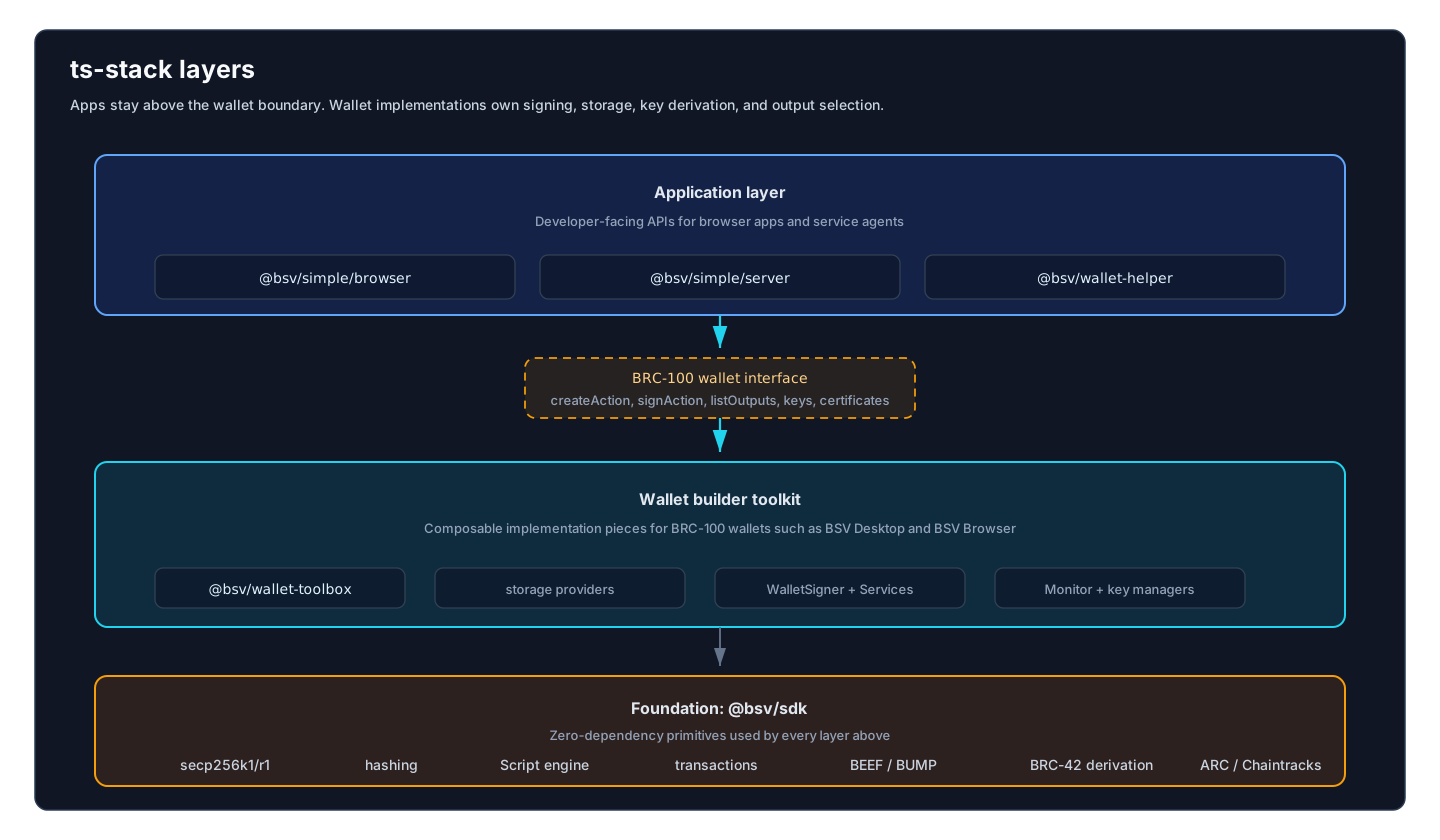
The stack is organized in three primary layers with supporting components that connect horizontally.
Adjacent Capabilities
These packages are not a fourth vertical layer. They sit alongside the main stack and usually connect through the BRC-100 wallet interface, @bsv/sdk primitives, or direct service APIs.
| Capability | Packages | What it provides | Connects through |
|---|---|---|---|
| Data overlays | @bsv/overlay, @bsv/overlay-express, @bsv/overlay-topics | Topic managers, lookup services, SHIP/SLAP discovery, and shared on-chain context | @bsv/sdk transactions, overlay services |
| P2P messaging and payments | @bsv/message-box-client, @bsv/authsocket, @bsv/paymail | Store-and-forward encrypted messages, live authenticated channels, BRC-29 payment derivation | BRC-100 wallet, BRC-103/104 auth |
| Identity | @bsv/auth-express-middleware, @bsv/authsocket | BRC-31 HTTP handshake and peer identity framework | BRC-100 wallet, BRC-103/104 peer framework |
| Monetization | @bsv/402-pay, @bsv/payment-express-middleware | BRC-121 HTTP 402 plus the distinct legacy authenticated payment flow | BRC-100 wallet; BRC-121 for 402-pay; BRC-103/104 + BRC-29 for PaymentExpress |
| Tokens | @bsv/btms, @bsv/btms-permission-module | Token metadata, wallet permission display context, and BRC-48 PushDrop flows | BRC-100 wallet, overlay topics |
| Storage | @bsv/overlay-topics, UHRP | Universal Hash Resolution for content-addressed files | UHRP servers, BRC-26 |
Foundation: @bsv/sdk
@bsv/sdk is the only zero-dependency package in the stack. It provides every primitive the other layers build on:
- Cryptography — secp256k1 and secp256r1 ECDSA, Schnorr, ECDH; SHA-256/512, RIPEMD-160, HMAC
- Script engine — Full Bitcoin Script interpreter and template system
- Transactions — Transaction builder, serialization, fee model, UTXO handling
- BEEF —
Beefclass: BRC-62 encoding/decoding, streaming validation ordering - Merkle paths —
MerklePathclass: BRC-74 BUMP format, compound path support - Key derivation — BRC-42 BKDS, BRC-43 security levels
- Network —
ArcBroadcasterfor transaction submission;ChaintracksClientfor block headers - BRC-100 types — Interface definitions consumed by wallet-toolbox and wallet clients
No dependencies means no node_modules vulnerabilities in the cryptographic core.
BRC-100 Boundary
The BRC-100 wallet interface is the single most important seam in the stack. It separates:
- Above — Application business logic. Uses
createAction,signAction,listOutputs,listActions,internalizeAction, and cryptographic primitives. Does not manage keys or storage. - Below — Wallet/key management. Implements storage, signing, key derivation, UTXO selection, Merkle proof acquisition. Does not know what the application is building.
Any BRC-100-compliant wallet can be swapped below this boundary without changing application code.
Wallet Builder Toolkit: @bsv/wallet-toolbox
@bsv/wallet-toolbox is not a single monolithic wallet. It is a set of composable modules:
| Module | Role |
|---|---|
WalletStorageManager | Orchestrates persistence providers (active + backup + incremental sync) |
KnexWalletStorage | SQL persistence (SQLite, MySQL, PostgreSQL) |
IndexedDBWalletStorage | Browser persistence |
RemoteWalletStorage | Remote storage over HTTPS (for relay setups) |
Monitor | Background daemon: confirms transactions, acquires Merkle proofs, rebroadcasts stalled txs |
PrivilegedKeyManager | Handles the privileged-mode keyring for identity operations |
ShamirWalletManager | Shamir secret sharing for key backup |
WalletSigner | Bridges BRC-100 signAction to @bsv/sdk signing internals |
Services | Container wiring ARC, Chaintracks, WhatsOnChain |
Wallet builders compose these into a BRC-100 Wallet. The resulting object is the same interface that @bsv/simple and other app-layer packages use.
Application Layer: @bsv/simple
@bsv/simple is the recommended entry point for most application developers. @bsv/simple/browser returns a high-level browser wallet that wraps the SDK WalletClient; advanced callers can access the raw BRC-100 client with wallet.getClient(). Within a browser app, that client discovers an available wallet over localhost, postMessage, JSON API, or another supported substrate and exposes methods such as createAction and listOutputs without the app ever holding private keys.
@bsv/wallet-toolbox is for developers building wallets, not applications. If you have a strong opinion about wallet UX or are building a competing wallet implementation, wallet-toolbox is where you start.
Two entry points in @bsv/simple:
@bsv/simple/browser — Browser entry point. Communicates with the user's BRC-100 wallet over localhost, postMessage, or another SDK wallet substrate. The app never holds private keys. Exports include createWallet, Wallet, Overlay, Certifier, DID, CredentialSchema, CredentialIssuer, and MemoryRevocationStore.
@bsv/simple/server — Manages a self-custodial server wallet from a private key, using a wallet storage endpoint such as Wallet Infra. Suitable for automated agents, backend services, and MCP servers. Exports include ServerWallet, ServerWalletManager, FileRevocationStore, handler factories, JsonFileStore, IdentityRegistry.
Direct service access
Application code can also communicate with overlays, message box servers, and UHRP storage servers independently of the wallet. The wallet is only required for operations that need private keys. Private keys stay on the user's device at all times; the wallet interface is the architectural boundary separating key material from application code.
Related
- Key Concepts — Terminology and protocol concepts
- BEEF (BRC-62) — Transaction format details
- BRC-100 Interface — Full method surface, labels/tags, batching
- Conformance Pipeline — How the TS stack drives cross-language compatibility